

 ChatGPT
 Claude
 Grok
Grok
 Perplexity
 Gemini
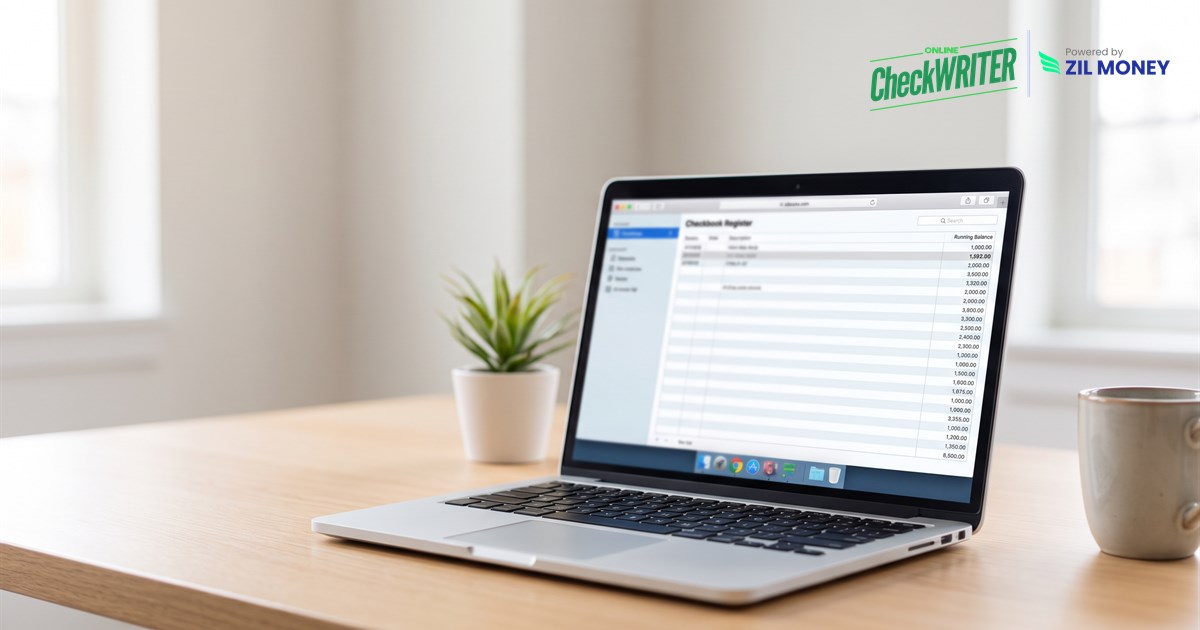
Ditch the smudged ledger. An online checkbook register logs every check automatically, shows a live running balance, and gives you a searchable history you can actually trust.
Key Takeaways
- An online checkbook register replaces the paper ledger with a digital record that updates itself.
- Every check you print or mail is logged automatically, so entries never go missing.
- A running balance stays current in real time, which makes reconciling faster.
- Searchable history gives you an audit trail for taxes, disputes, and vendor questions.
- Manual math errors and forgotten entries mostly disappear once the software does the tracking.
- OnlineCheckWriter.com keeps printing, mailing, and record-keeping together in one place.
An online checkbook register is a digital tool that records every check and transaction in one running list instead of a paper booklet. If you still track payments by hand, you already know the pain of a missed entry or a balance that never quite matches the bank. Because the numbers live in software, the math updates on its own and nothing hides in the margins. You get a clear picture of what cleared, what is still outstanding, and what your true balance is today. Moreover, you can search months of history quickly rather than flipping pages. OnlineCheckWriter.com, powered by Zil Money builds this kind of register right into its check platform.
The Real Problems With a Paper Checkbook Register
A paper register works fine until the day it does not. Then one small slip snowballs into hours of cleanup at month-end.
- Missed entries: You write a check in a hurry and forget to log it. As a result, your balance is wrong for weeks, and you only notice when the account overdraws. One skipped line can throw off every number below it.
- Manual math mistakes: Every entry depends on you subtracting correctly. However, tired eyes and quick math produce errors that compound down the page. A single transposed digit can hide a real shortfall.
- No audit trail: A paper ledger cannot tell you who entered what or when. Because there is no history, disputes with vendors turn into guesswork. Tax season then becomes a scramble to reconstruct records.
- Painful reconciliation: Matching a handwritten register to a bank statement means checking each line by hand. So a task that should take minutes stretches into an evening. Meanwhile, small discrepancies are easy to miss entirely.
- Lost or damaged books: A register is one coffee spill away from disaster. If the booklet goes missing, your only record of months of payments goes with it. Recreating that history is nearly impossible.
- No visibility for your team: Only the person holding the book can see it. Therefore your bookkeeper, partner, or AP clerk works blind. Shared spending decisions suffer when nobody agrees on the real balance.
“When your ledger updates itself, the month-end scramble simply stops happening.”
How OnlineCheckWriter.com Solves These Problems With an Online Checkbook Register
Each fix below maps to a problem above, so the manual gaps close one by one.
- Automatic logging: Every check you create is recorded the moment you print it. Because the entry happens on its own, missed lines are no longer a risk. Your online checkbook register stays complete without extra effort. You can print checks on demand and watch each one post to the register right away.
- A live running balance: The software does the math for you. As a result, your balance reflects every transaction the second it is added. You always know what is truly available before you send the next payment.
- A searchable audit trail: Every record is timestamped and stored, so you can filter by date, payee, or amount quickly. This gives you the history that a paper book never could. When a vendor questions a payment, the answer is one search away.
- Effortless reconciliation: Because the register and your check activity live together, matching them is straightforward. So month-end takes far less time, and discrepancies surface early instead of hiding at the bottom of a page.
- Connected mailing and invoicing: When you mail a check or bill a client through invoice management, the activity ties back to your records. Therefore your payment history and your register tell the same story. Nothing lives in a separate silo.
- Shared access for your team: Your bookkeeper and AP staff can view the same register you do. In addition, everyone works from one current balance instead of a private notebook. To go deeper on the concept, see the full checkbook register overview.
Trade the Paper Ledger for a Live Register
Log every check automatically, watch a running balance, and search your history quickly.
Why Digital Check Tracking Matters
Cash visibility is not a nice-to-have for a small business. It is survival. When you cannot see your true balance, you cannot make confident decisions about payroll, rent, or the next vendor invoice.
The scale of the risk is well documented. According to the JPMorgan Chase Institute, the median small business holds just 27 days of cash buffer in reserve. In other words, most owners are running close to the edge. A wrong balance or a missed check entry can push a healthy month into an overdraft fast.
An online checkbook register narrows that gap. Because every check is logged and every balance is current, you spot problems days earlier. Then you can act before a shortfall becomes a bounced payment. That kind of early warning is hard to get from a paper ledger.
OnlineCheckWriter.com keeps your printing, mailing, and record-keeping in one connected place. If you want to trade the paper booklet for a register that keeps itself current, it is worth a look. Sign up today to see how the online checkbook register fits your workflow.
Frequently Asked Questions
What is an online checkbook register?
How is it better than a paper register?
Does it track checks I print and mail?
Can my bookkeeper see the same register?
Is my check history easy to find later?
OnlineCheckWriter.com, powered by Zil Money, is a financial technology company and not a bank. Banking services are provided by our partner bank, Member FDIC. FDIC insurance applies only to eligible products associated with those that have funds held in accounts at the partner bank, subject to applicable limits and requirements.