

 ChatGPT
 Claude
 Grok
Grok
 Perplexity
 Gemini
Quick answer: No, and if you print a real check on plain paper it risks getting held or rejected. But you can still print your own checks in-house, the same day you need one, without waiting on a mailed checkbook. All it takes is MICR-compatible check stock and a printer set up for magnetic-ink printing, not a sheet from the office copier.
Key Takeaways
Why This Comes Up for a Small Auto Glass Shop
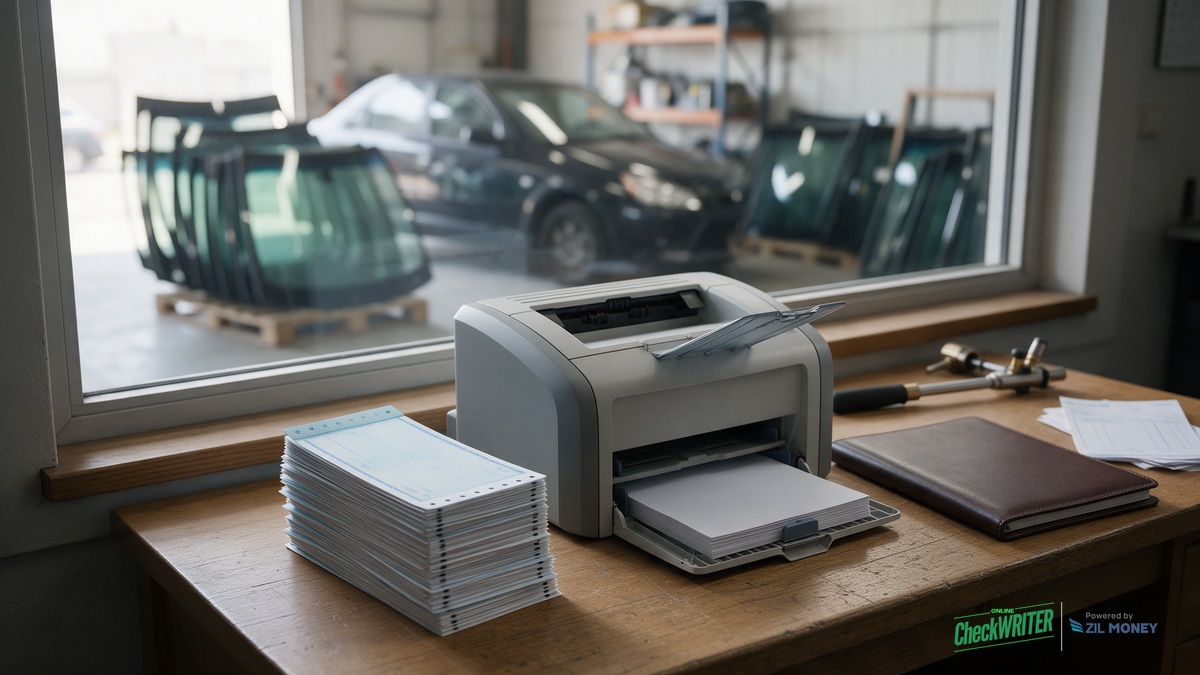
A one-location auto glass repair shop in Fort Wayne, Indiana, might write only a dozen checks a month: a glass distributor, a part-time technician, the landlord. When the checkbook runs low right before a delivery, it’s tempting to grab the office printer and a blank sheet of paper for one check. Here’s the honest answer before a real payment is on the line.
What Actually Happens If You Print a Check on Regular Paper?
A bank’s equipment reads the routing and account number line at the bottom of a check using magnetic ink character recognition, known as MICR. Regular copy paper run through a standard inkjet or laser printer with ordinary toner does not produce a line the equipment can read reliably. A poor but legible line often just goes to manual repair, where someone at the bank keys in the details by hand and the check still pays, only slower. A line that’s unreadable, or paper that doesn’t meet a bank’s format standards, risks an outright hold or rejection instead.
Is Printing Your Own Checks Even Legal?
Yes. Nobody cares who printed the check; banks care whether it meets the same MICR and format standards a pre-printed checkbook check does. Get the MICR line right and it clears like any other check. Banks differ on the fine print, so confirm with your own bank before you run your first real batch. For general background on how banks handle check processing and funds availability in the US, see the Federal Reserve’s guide to Regulation CC.
Regular Paper vs. MICR Check Stock: What Actually Changes
| What Changes | Regular Paper | MICR Check Stock |
|---|---|---|
| Bank processing | Line may not be machine-readable; risk of a hold or rejection | Built to be read by a bank’s reader-sorter equipment |
| Where to get it | Already in the office printer tray | Ordered as blank check stock, kept on hand like paper is |
| Printer needed | Any standard printer | A printer set up for magnetic-ink (MICR) printing |
| Fraud/security features | None built in | Stock typically includes security features like a void pantograph |
Mistakes Small Shops Make Trying to Print Checks Themselves
- Assuming any printer can handle magnetic ink. Most standard inkjet and laser printers are not set up for MICR toner unless configured for it.
- Using a check template found online without verified, compliant stock. A correct-looking layout on the wrong paper still fails the bank’s own read.
- Skipping a test print before running a real batch. Confirm alignment on a blank sample before committing stock to a real payment.
- Mailing a plain-paper check to a vendor who deposits by mobile capture. A held or rejected check delays the vendor relationship, not just your own books. Mobile deposit tends to be less forgiving of a borderline print than a teller or branch scanner, so a compliant check matters most on that path.
- Reusing or skipping check numbers. Print checks with unique, sequential numbers, and never let two checks off the same account share a number; banks watch for duplicate check numbers as a routine fraud signal.
- Skipping positive pay. If you’re printing checks in-house on demand rather than from a pre-numbered box, ask your bank about enrolling in positive pay, where you send the bank a list of checks you’ve issued so it can flag anything that doesn’t match.
For a one-location shop like the Fort Wayne example, most of these mistakes trace back to the same root cause: treating in-house printing like a one-time errand instead of a small standing process with its own checklist, run the same way each time a distributor payment or a technician’s check comes due.
What Do You Actually Need to Print Compliant Checks In-House?
- MICR-compatible blank check stock, kept on hand the way you’d keep regular paper stocked.
- A monochrome laser printer configured for magnetic-ink printing, using a MICR-toner cartridge sold alongside compliant check stock, or a check-printing service that handles the MICR line correctly for you.
- A check-writing account where you can enter the payee, amount, and memo, then preview the layout before printing.
- A test print on a blank sample to confirm alignment before running a real payment, such as this month’s glass-distributor invoice or a technician’s check.
- Your own printed and signed check, ready as soon as you print it, instead of waiting on a mailed reorder.
Print Your First Compliant Check Today
Once your stock and printer are set up, print a real, bank-ready check the moment you need one, no drawer full of pre-printed stock sitting around.
Frequently Asked Questions
Can I print a check on regular printer paper?
No. Regular paper doesn’t carry a magnetic-ink line a bank’s equipment can reliably read, so the check often needs manual repair and clears slower, or in a worse case gets held or rejected.
Why does a check need magnetic ink at all?
Banks use automated reader-sorter machines to process checks at scale, and those machines read the routing and account line using magnetic ink character recognition (MICR), not plain toner.
Is it legal for a small business to print its own checks?
Yes. A properly printed check on compliant stock is processed the same way a pre-printed checkbook check is; the legal framework doesn’t require a bank or print shop to be the one that printed it.
What printer works for MICR check printing?
A printer set up for magnetic-ink printing, typically a laser printer loaded with MICR toner. A standard inkjet using ordinary ink is not built for this.
Will a vendor notice the difference between a pre-printed checkbook check and one I printed myself?
A properly printed check on compliant stock includes the same fields and security features a vendor already expects, so it generally deposits the same way a pre-printed checkbook check does. Mobile deposit is the one path worth watching, since it tends to be less forgiving of a borderline print than a teller or branch scanner.
Is printing checks in-house worth it for a shop that only writes a few checks a month?
Usually yes. A shop writing a dozen checks a month prints on demand instead of ordering a full box of pre-printed checks it may not use up for months.
What happens if a bank rejects a check I printed?
A rejected or held check delays payment to whoever you were paying. Using MICR-compliant stock and a properly configured printer from the start reduces the chance of a hold or rejection tied to the check itself.
Do I need to keep a box of blank check stock on hand?
Yes, the same way you’d keep regular paper stocked. The stock itself is MICR-compatible; paired with a printer set up for magnetic-ink printing, it’s built to be processed the way a pre-printed checkbook check is.
OnlineCheckWriter.com – Powered by Zil Money, is a financial technology company and not a bank. Banking services are provided by our partner bank, Member FDIC. FDIC insurance applies only to eligible products associated with those that have funds held in accounts at the partner bank, subject to applicable limits and requirements.